The finance tech stack has quietly become a liability
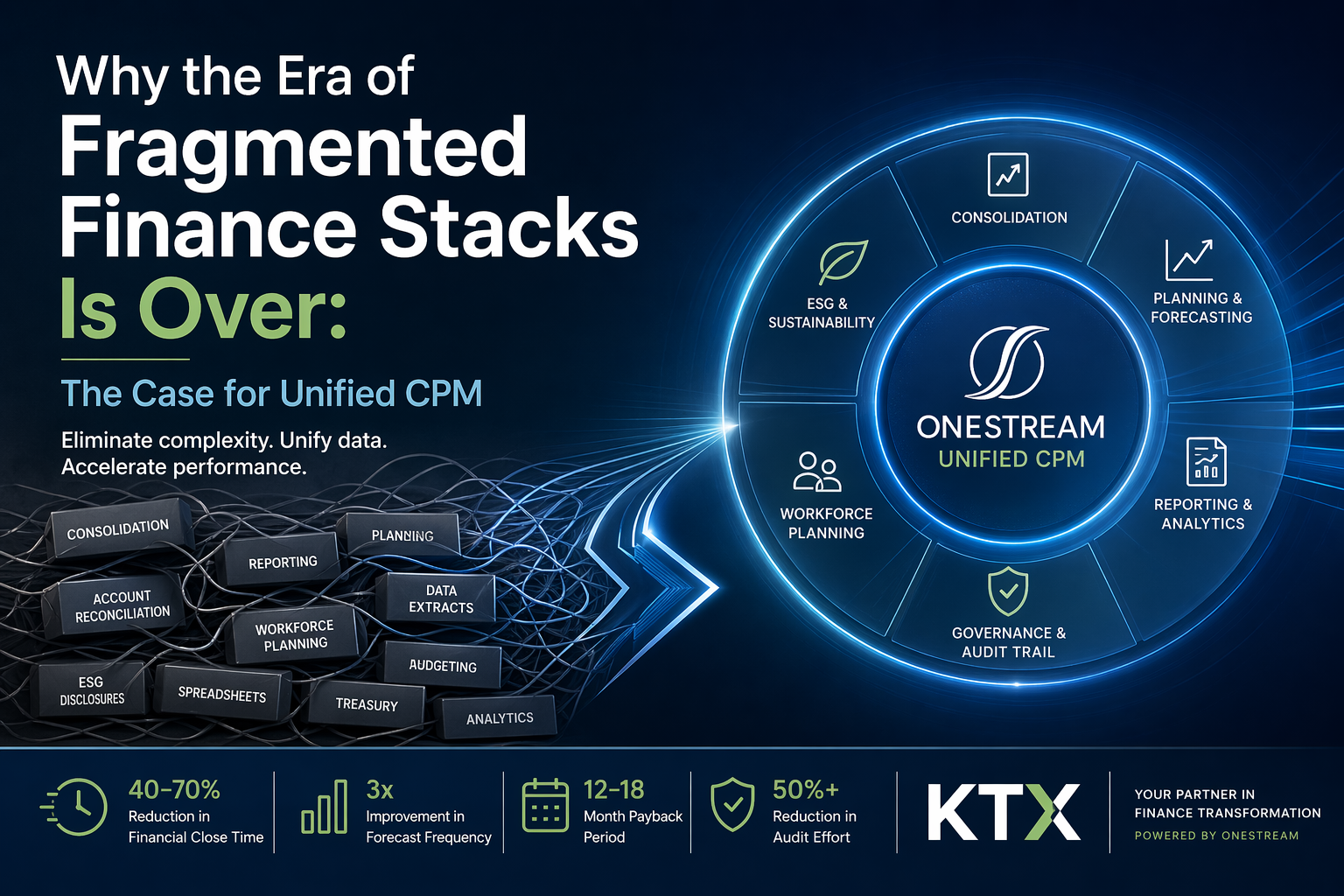
Over the past decade, finance leaders have accumulated software the way organizations accumulate cloud subscriptions: one urgent problem at a time. A consolidation tool here. A planning tool there. A separate system for account reconciliations, another for financial reporting, a fourth for workforce planning, a fifth for ESG disclosures.
The result? According to Gartner’s 2024 CFO survey, the average large enterprise now runs between 12 and 15 distinct applications inside the office of finance. Ventana Research found that 62% of finance organizations cite data integration and reconciliation as the single biggest obstacle to faster close and more reliable forecasting.
This isn’t a tooling problem. It’s a strategic liability — and forward-looking CFOs are beginning to treat it as one.
The hidden tax on fragmented finance
When finance data lives across disconnected systems, three costs compound quietly on the balance sheet:
- The reconciliation tax. APQC benchmarks show that high-performing finance organizations close their books in 4.8 days, while bottom-quartile peers take 10 or more. The single largest driver of that gap isn’t headcount or geography — it’s the time spent reconciling data between systems that were never designed to speak to each other.
- The forecasting lag. In a PwC Pulse survey, 56% of CFOs said they lack confidence in their forward-looking numbers because the data supporting those forecasts originates in systems with different hierarchies, different metadata, and different definitions of “actuals.” By the time finance reconciles the inputs, the forecast is already stale.
- The opportunity cost. Deloitte estimates that finance teams spend roughly 60-70% of their capacity on transactional and reconciliation work, leaving less than a third for analysis, scenario modeling, and strategic partnership with the business. For a 200-person global finance organization, that’s the equivalent of 120+ FTEs dedicated to moving numbers between systems.
Fragmentation doesn’t just slow finance down. It structurally limits what finance can contribute to enterprise value.
Why unification is now a board-level conversation
Three shifts are pushing unified Corporate Performance Management (CPM) from “nice-to-have” to strategic imperative:
- Volatility demands continuous planning. Annual budgets anchored in Excel consolidations can’t keep up with tariff shifts, supply chain disruptions, and rapid interest rate moves. CFOs need rolling forecasts refreshed weekly — impossible when data flows through seven systems.
- AI amplifies good data and punishes bad data. Generative AI and machine learning deliver real value in variance analysis, anomaly detection, and driver-based forecasting — but only when the underlying data model is consistent. Feeding AI fragmented, reconciled-after-the-fact data produces fragmented, unreliable output.
- Expanding CFO mandates. ESG reporting, tax transparency (Pillar Two), and real-time treasury are no longer adjacent concerns. They’re now finance responsibilities. Bolting more point solutions onto an already-fragmented stack makes each new mandate exponentially more expensive to execute.
What “unified” actually means
Unified CPM is often misunderstood as “one vendor” or “one dashboard.” It’s neither.
A genuinely unified CPM platform delivers four properties that fragmented stacks structurally cannot:
- A single data model across consolidation, planning, reporting, account reconciliation, and analytics — so that actuals, forecasts, and scenarios all reference the same dimensions, hierarchies, and governance rules.
- One audit trail from transaction to board report, eliminating the reconciliation cycles that dominate month-end.
- Extensibility without fragmentation, meaning new use cases (ESG, tax, workforce planning, capex) can be deployed on the same platform rather than added as new silos.
- Embedded intelligence, where AI and ML operate natively on governed data rather than on exports and extracts.
OneStream is the clearest embodiment of this architecture on the market today — purpose-built around a single data model and designed to replace the patchwork of Hyperion, SAP BPC, Anaplan, and spreadsheet layers that most enterprises still rely on.
The ROI case: what the data shows
Independent analysis by Nucleus Research and Forrester’s Total Economic Impact studies on unified CPM implementations consistently show:
- 40-70% reduction in financial close time after consolidating onto a unified platform
- 3x improvement in forecast frequency (from quarterly to monthly or weekly cycles)
- Payback periods of 12-18 months, driven primarily by FTE redeployment and licensing consolidation
- 50%+ reduction in audit preparation effort due to single-source data lineage
These aren’t marginal productivity gains. They represent a structural shift in what finance can deliver to the enterprise.
The decision facing CFOs in 2026
The question is no longer whether fragmented finance stacks are sustainable. The evidence says they aren’t. The real question is whether your organization replatforms proactively — on its own timeline and strategy — or reactively, after a failed close, a missed forecast, or an audit finding forces the conversation.
The CFOs who will define the next decade of finance leadership are the ones treating platform consolidation not as an IT project, but as a strategic capability investment.
Ready to evaluate what unified CPM looks like for your organization?
At KTX, we’ve helped finance leaders across industries replace fragmented stacks with OneStream’s unified platform — accelerated by CPMx, our purpose-built OneStream solution — and quantify the impact before a single line of configuration is written.
Contact the KTX team to talk with a CPM expert about your current stack, your consolidation and planning pain points, and what a unified architecture could deliver for your finance function.