Let’s Connect at Splash 2026

Splash is back — and this year’s gathering is shaping up to be the most important one yet for finance leaders navigating the next wave of CPM transformation.

As OneStream’s flagship conference, Splash brings together CFOs, FP&A leaders, and finance transformation teams from across the globe to exchange ideas, see what’s next on the platform roadmap, and learn from the organizations pushing CPM further than anyone thought possible. For the KTX team, it’s the single best week of the year to connect face-to-face with the community we’ve built our practice around.

Why Splash 2026 matters

The conversations happening in finance right now are different from a year ago. AI has moved from promise to production. Continuous planning is replacing static budgets. ESG, tax, and treasury are converging onto the same platforms that run consolidation and close. Splash 2026 is where those conversations go from hallway chatter to practical, implementable strategy.

Whether you’re early in your OneStream journey, scaling an existing deployment, or evaluating a move off legacy EPM, this is the room where the answers are.

What we’ll be focused on

At Splash 2026, the KTX team will be talking with finance leaders about the trends defining the year ahead:

  • Operationalizing AI in the office of finance — what’s actually working, and what’s still hype
  • Unified CPM as a replatforming strategy — lessons from enterprises retiring Hyperion, BPC, and fragmented point solutions
  • Extending OneStream beyond core finance — workforce, capex, ESG, and tax on a single platform
  • Driving faster time-to-value with CPMx — how our OneStream solution helps organizations compress implementation timelines without compromising governance

Let’s make your time at Splash count

Conferences move fast. The most valuable conversations are almost always the ones booked ahead of time — not the ones squeezed between sessions.

If you’re attending Splash 2026 and want to talk through where your finance organization is headed, we’d love to connect. Our team includes senior OneStream practitioners, solution architects, and finance transformation advisors who’ve helped organizations across industries get measurable value from the platform — and from CPMx, our OneStream solution built to accelerate that value.

Whether you’re looking for a second opinion on your roadmap, a benchmark against peers, or a partner for your next initiative — we’re here for the conversation.

Book a meeting with KTX at Splash 2026

Spots fill up quickly once the conference begins. Reserve time with our team now and we’ll make sure your Splash experience delivers something you can take back to your organization.

Book a meeting with the KTX team at Splash 2026 by emailing info@ktxsolutions

See you there.

7 Signs Your OneStream Implementation Is Ready for a Health Check

Meta description: If your OneStream close is getting slower, your business rules are a mystery, or your team is rebuilding processes in Excel — it may be time for a health check. Seven signs to look for.

Target keyword: OneStream health check

Estimated read time: 6 minutes


Most OneStream implementations do not fail in obvious ways. They erode. A consolidation that used to run in four minutes drifts to nine. A business rule that made sense when someone wrote it in 2021 is now untouched and feared. Month-end close finishes, but only because two senior analysts spend their evenings fixing the same five things every cycle.

None of this triggers an incident. None of it shows up on a dashboard. It just slowly takes back the time, trust, and agility that OneStream was supposed to give your finance team in the first place.

At KTX Solutions, when we run a OneStream health check for a customer, we are almost never looking for catastrophic failures. We are looking for the quiet drift that has accumulated since go-live. Below are the seven clearest signals that it is time to take a hard look.

1. Your consolidation or calculation runtimes are creeping up

Performance is the canary. If a monthly consolidation that used to run in three or four minutes now takes eight or ten, the application is trying to tell you something — usually about cube density, stored vs. dynamic calculations, member formulas that should have been business rules, or data that should have been archived two years ago.

The fix is rarely hardware. It is almost always design. If nobody on your team has benchmarked your current runtimes against what they were six months ago, that is the first thing to do, and the answer will tell you whether a deeper look is warranted.

2. Month-end close has the same three recurring fire drills every cycle

Talk to your FP&A team and ask them to name the three things that most often go wrong during close. If they can answer instantly — the intercompany elimination that always needs to be rerun, the data load that routinely fails on Day 2, the currency translation that only the one senior analyst knows how to fix — those are symptoms of fixable design or governance problems.

Recurring fire drills are not close issues. They are unaddressed implementation debt wearing a close issue costume. A health check surfaces them and prioritizes the ones worth fixing now versus at the next release.

3. Nobody on your team can fully explain what certain business rules do

Every OneStream environment has them. A business rule from the original implementation, written by a consultant who is no longer at the firm, with a name like CALC_ADJ_FINAL_V3 and a comment at the top that just says “do not modify.” Maybe it runs on every consolidation. Maybe it has not been reviewed in three years.

The moment a business rule exists that your current team cannot confidently explain and modify, you have both a risk and a ceiling. The risk is that it breaks or produces a subtly wrong number. The ceiling is that every future enhancement has to work around it rather than through it. A good health check documents every custom rule, flags the ones that are fragile or redundant, and gives you a plan to rationalize them.

4. Your security and workflow setup has drifted

OneStream security is simple to set up and easy to let go. In year one, you build clean role-based groups and a tight workflow model. By year three, you may have forty groups, half of them with one or two members, permissions that accumulated “just in case,” and workflow profiles that no longer match how your actual close is organized.

This drift is invisible until it is not — when an auditor asks for a user access review, when someone leaves and nobody is sure what access needs to be revoked, or when a new entity onboarding takes three weeks because the permissions model is too tangled to extend cleanly. A health check gives you a rationalized security model and workflow structure that your team can actually maintain.

5. You have not taken a OneStream release in more than twelve months

OneStream ships meaningful platform updates several times a year. If your environment is more than one major release behind, you are missing not only features and performance improvements but also MarketPlace solution updates and fixes that other customers are already benefiting from.

The reason finance teams stall on upgrades is almost always the same — the last upgrade was painful, nobody wants to repeat the experience, and there is no clear-eyed plan for what a smooth upgrade would look like. A health check gives you an honest readiness assessment, a list of the specific risks in your environment, and a path to get current without the last upgrade’s drama.

6. Your users have built shadow processes in Excel around OneStream

This is the one most finance leaders are quietly aware of and slow to address. OneStream was supposed to eliminate the tangle of spreadsheets. Three years in, you notice an analyst is exporting data into Excel every month to reconcile it, or an FP&A manager maintains a “real” forecast in a workbook that does not live in OneStream at all.

Every shadow process is feedback. It is a user telling you, through their behavior, that OneStream is not doing something they need it to do — or that they do not trust the number they are getting. Sometimes the answer is a configuration change. Sometimes it is a MarketPlace solution nobody has turned on. Sometimes it is genuine training. You cannot know until you surface them and look at each one. That is a core part of what a health check is for.

7. Every new requirement takes longer to deliver than the last one

This is the signal that is hardest to see from the inside, but it is the most important. When OneStream is healthy, each new requirement — a new entity, a new plan, a new report, a new MarketPlace module — is roughly as fast to deliver as the one before it. When OneStream is not healthy, each new requirement takes a little longer than the last one did, because every new thing has to bend around accumulated technical debt.

If you are looking at a new initiative — acquiring a company, adding a planning model, launching ESG or capital planning — and your honest instinct is “this is going to be painful,” your OneStream environment is telling you it needs a foundation check before, not after, the new work begins.

What a OneStream health check actually produces

The deliverable of a good health check is not a fifty-page report. It is a short, prioritized list. Usually fewer than ten items, with each one scored on impact, effort, and urgency. Every item is specific enough to act on — “refactor these three business rules before the next release” — not generic advice like “improve performance.”

A typical KTX engagement takes two to three weeks of combined discovery, environment review, and interviews with your finance and IT stakeholders. You get the prioritized action list, the underlying findings, and a recommendation on which items your team can handle internally versus which ones benefit from outside help.

Where to go from here

If more than two of the seven signs above describe your environment, the answer is not to wait. OneStream debt compounds the same way any technical debt does — quietly for a while, and then all at once, usually right before your highest-stakes close or your biggest new initiative.

If you would like a no-pressure conversation about what a OneStream health check would look like for your environment, get in touch with the KTX Solutions team. We will give you an honest read on whether there is anything worth doing, and a clear view of what it would take.
Why the Era of Fragmented Finance Stacks Is Over: The Case for Unified CPM

The finance tech stack has quietly become a liability

Over the past decade, finance leaders have accumulated software the way organizations accumulate cloud subscriptions: one urgent problem at a time. A consolidation tool here. A planning tool there. A separate system for account reconciliations, another for financial reporting, a fourth for workforce planning, a fifth for ESG disclosures.

The result? According to Gartner’s 2024 CFO survey, the average large enterprise now runs between 12 and 15 distinct applications inside the office of finance. Ventana Research found that 62% of finance organizations cite data integration and reconciliation as the single biggest obstacle to faster close and more reliable forecasting.

This isn’t a tooling problem. It’s a strategic liability — and forward-looking CFOs are beginning to treat it as one.

The hidden tax on fragmented finance

When finance data lives across disconnected systems, three costs compound quietly on the balance sheet:

  1. The reconciliation tax. APQC benchmarks show that high-performing finance organizations close their books in 4.8 days, while bottom-quartile peers take 10 or more. The single largest driver of that gap isn’t headcount or geography — it’s the time spent reconciling data between systems that were never designed to speak to each other.
  2. The forecasting lag. In a PwC Pulse survey, 56% of CFOs said they lack confidence in their forward-looking numbers because the data supporting those forecasts originates in systems with different hierarchies, different metadata, and different definitions of “actuals.” By the time finance reconciles the inputs, the forecast is already stale.
  3. The opportunity cost. Deloitte estimates that finance teams spend roughly 60-70% of their capacity on transactional and reconciliation work, leaving less than a third for analysis, scenario modeling, and strategic partnership with the business. For a 200-person global finance organization, that’s the equivalent of 120+ FTEs dedicated to moving numbers between systems.

Fragmentation doesn’t just slow finance down. It structurally limits what finance can contribute to enterprise value.

Why unification is now a board-level conversation

Three shifts are pushing unified Corporate Performance Management (CPM) from “nice-to-have” to strategic imperative:

  • Volatility demands continuous planning. Annual budgets anchored in Excel consolidations can’t keep up with tariff shifts, supply chain disruptions, and rapid interest rate moves. CFOs need rolling forecasts refreshed weekly — impossible when data flows through seven systems.
  • AI amplifies good data and punishes bad data. Generative AI and machine learning deliver real value in variance analysis, anomaly detection, and driver-based forecasting — but only when the underlying data model is consistent. Feeding AI fragmented, reconciled-after-the-fact data produces fragmented, unreliable output.
  • Expanding CFO mandates. ESG reporting, tax transparency (Pillar Two), and real-time treasury are no longer adjacent concerns. They’re now finance responsibilities. Bolting more point solutions onto an already-fragmented stack makes each new mandate exponentially more expensive to execute.

What “unified” actually means

Unified CPM is often misunderstood as “one vendor” or “one dashboard.” It’s neither.

A genuinely unified CPM platform delivers four properties that fragmented stacks structurally cannot:

  1. A single data model across consolidation, planning, reporting, account reconciliation, and analytics — so that actuals, forecasts, and scenarios all reference the same dimensions, hierarchies, and governance rules.
  2. One audit trail from transaction to board report, eliminating the reconciliation cycles that dominate month-end.
  3. Extensibility without fragmentation, meaning new use cases (ESG, tax, workforce planning, capex) can be deployed on the same platform rather than added as new silos.
  4. Embedded intelligence, where AI and ML operate natively on governed data rather than on exports and extracts.

OneStream is the clearest embodiment of this architecture on the market today — purpose-built around a single data model and designed to replace the patchwork of Hyperion, SAP BPC, Anaplan, and spreadsheet layers that most enterprises still rely on.

The ROI case: what the data shows

Independent analysis by Nucleus Research and Forrester’s Total Economic Impact studies on unified CPM implementations consistently show:

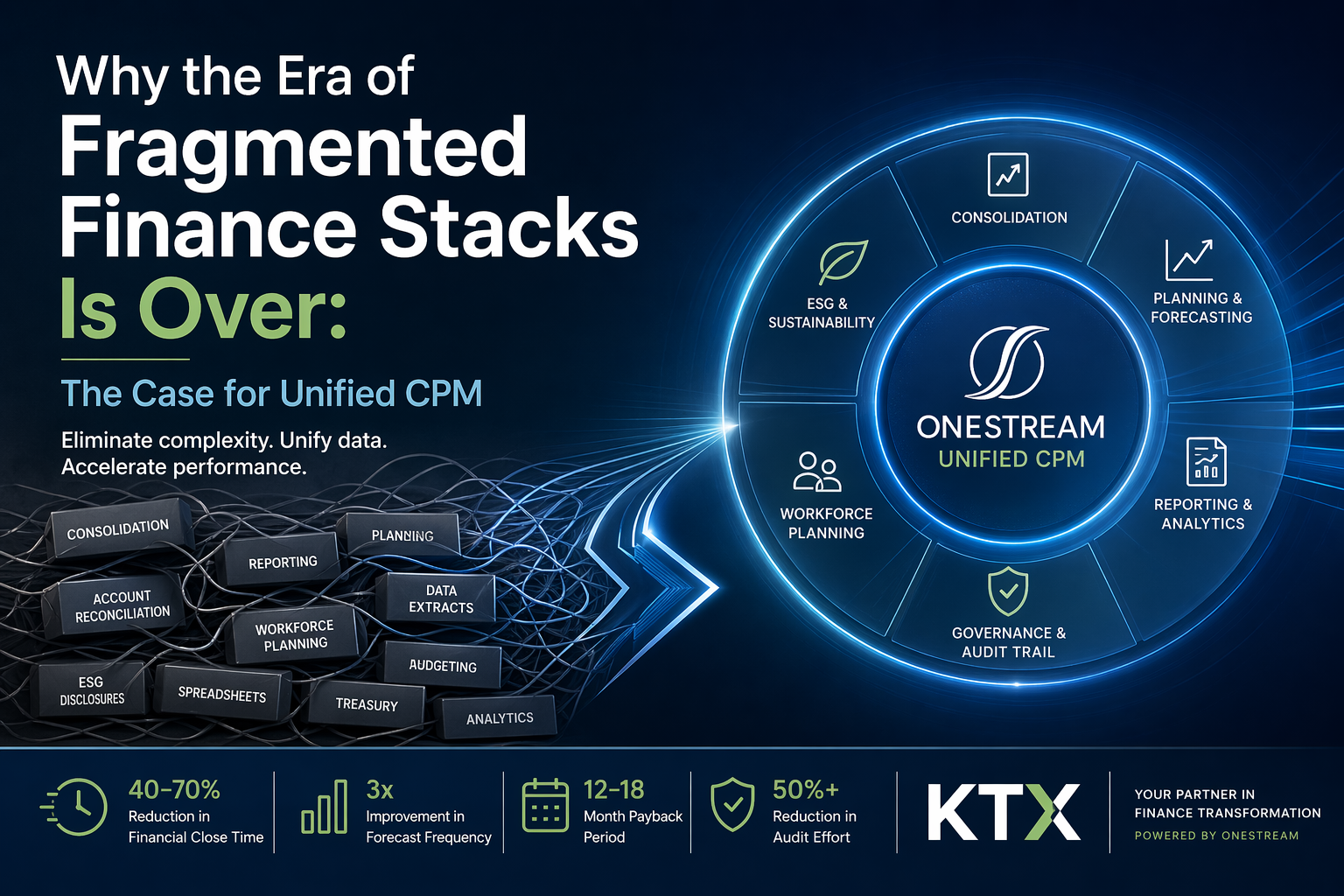
  • 40-70% reduction in financial close time after consolidating onto a unified platform
  • 3x improvement in forecast frequency (from quarterly to monthly or weekly cycles)
  • Payback periods of 12-18 months, driven primarily by FTE redeployment and licensing consolidation
  • 50%+ reduction in audit preparation effort due to single-source data lineage

These aren’t marginal productivity gains. They represent a structural shift in what finance can deliver to the enterprise.

The decision facing CFOs in 2026

The question is no longer whether fragmented finance stacks are sustainable. The evidence says they aren’t. The real question is whether your organization replatforms proactively — on its own timeline and strategy — or reactively, after a failed close, a missed forecast, or an audit finding forces the conversation.

The CFOs who will define the next decade of finance leadership are the ones treating platform consolidation not as an IT project, but as a strategic capability investment.


Ready to evaluate what unified CPM looks like for your organization?

At KTX, we’ve helped finance leaders across industries replace fragmented stacks with OneStream’s unified platform — accelerated by CPMx, our purpose-built OneStream solution — and quantify the impact before a single line of configuration is written.

Contact the KTX team to talk with a CPM expert about your current stack, your consolidation and planning pain points, and what a unified architecture could deliver for your finance function.