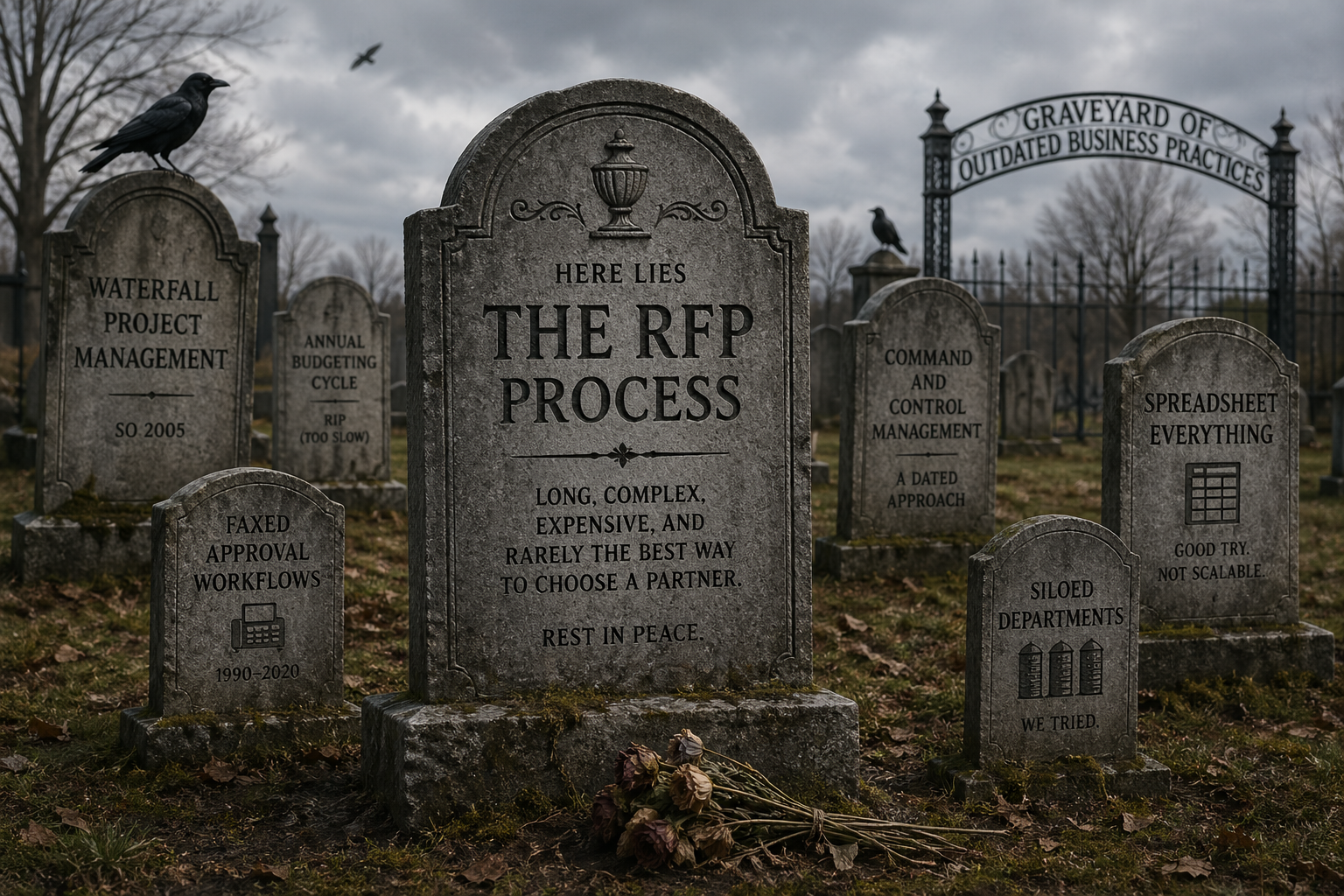
The Request for Proposal process hasn’t fundamentally changed in decades. Vendors receive a document, scramble to answer dozens of questions across PDF pages or forms, clients shuffle through thick binders of responses, and everyone wastes weeks in a cycle that rarely delivers the clarity needed to make a confident decision. For organizations evaluating mission-critical systems—especially enterprise software implementations—the traditional RFP is a relic that leaves money on the table and poor decisions in its wake.
It’s time to overhaul it.
Why the Current Process Fails
The standard RFP workflow is inefficient for all sides. My personal favorite RFP story illustrates just how broken the process has become. A few years back, I was responding to an RFP from a prospective client when I noticed something alarming: the RFP itself was recycled from a previous evaluation they’d conducted years earlier on an entirely different software package. References to unrelated products were still embedded in the questions. I was being asked to respond to requirements that didn’t apply to my solution, and the client clearly hadn’t reviewed their own document before sending it out. That’s the moment I realized we were all wasting our time—me crafting answers to irrelevant questions, them waiting for responses that wouldn’t help them evaluate fairly, and both of us going through motions that had nothing to do with finding the right fit.
Vendors spend days or weeks crafting responses that clients may never read in full. Clients receive answers crafted to check a box rather than genuinely address their needs. Questions go unanswered until a follow-up round that takes another week. Different stakeholders on the client side hear different information at different times, leading to inconsistent evaluation and second-guessing.
Worst of all, the format itself prevents real dialogue. An RFP is a monologue—clients ask, vendors answer, and nuance disappears in the written word.
A Better Approach: Live Webinars with Hidden Attendees
Imagine this instead: structured webinar sessions where vendors present and answer questions in real time, but the client controls visibility.
Here’s how it works:
All participating vendors attend the same webinar, but attendees are hidden from each other. The client moderates and ensures every vendor hears the same questions and answers, creating a level playing field. When a vendor asks “How will you measure success?” or “What’s your approach to data migration?”—it’s asked once, answered thoroughly, and heard by all competitors simultaneously.
This format delivers:
Consistency. Every vendor gets the same information. No more “Vendor A got a 30-minute call while Vendor B got 5 minutes.”
Efficiency. A two-hour webinar replaces days of back-and-forth. Questions are answered live with context and follow-up in real time.
Clarity. Clients hear tone, see expertise, and ask follow-up questions immediately—far more revealing than written responses.
Fairness. Hidden attendees mean vendors can’t game their answers based on competitor positioning. They answer authentically.
Time savings. For enterprise software evaluations, this cuts the traditional 4-6 week RFP cycle down to 2-3 weeks.
Structured Response Software: Making Comparison Effortless
But webinars alone aren’t enough. Vendors still need a way to document their approach, and clients still need to compare responses systematically.
Enter a dedicated RFP response platform. Think of it as a structured alternative to PDF form-filling, built specifically for enterprise software evaluations and built entirely by AI!
The vendor side: Instead of writing prose in text boxes, partners respond to requirements using a template-driven interface. The platform might include structured fields for approach, timeline, team composition, pricing assumptions, and risk mitigation. Vendors can reuse standard answers across multiple RFPs while customizing for specific client needs.
The client side: Responses feed into a comparison dashboard. Clients see Vendor A’s timeline against Vendor B’s against Vendor C’s—side by side. Filter by capability. Highlight conflicts. Add scoring or notes. Export a comparison matrix for stakeholder review.
The outcome: What once required reading three 40-page documents now takes 20 minutes. Decision-makers see patterns instantly. Red flags surface immediately.
Why This Matters Now
Enterprise software decisions—especially implementations of platforms like financial consolidation and budgeting systems—are too critical to rely on a broken process. The cost of a wrong choice is measured in millions and months of rework.
Buyers are sophisticated. Vendors understand their products deeply. The process should reflect that maturity, not hark back to an era of printed documents and courier deliveries.
The Path Forward
The webinar + structured response model isn’t revolutionary—it’s just modern. It respects everyone’s time, it surfaces truth more reliably than documents ever will, and it levels the playing field.
For procurement teams drowning in RFPs, for vendors tired of writing in the dark, and for organizations betting their financial operations on the right partner: a better way exists.
The question is whether you’re ready to adopt it.
About KTX Solutions
KTX Solutions is a OneStream-certified implementation partner specializing exclusively in financial consolidation, budgeting, and forecasting solutions since 2017. We work with organizations across oil & gas, manufacturing, utilities, telecommunications, and other complex industries to implement and optimize OneStream and related CPM platforms.
We understand the stakes of enterprise software selection because we live them every day with our clients. We’ve sat on both sides of the RFP table—as vendors responding to RFPs and as advisors helping clients evaluate CPM solutions fairly and thoroughly.
If your organization is evaluating CPM platforms, we can help you design and administer a modern RFP process. Whether you’re looking to implement a structured webinar format, build a comparison framework for vendor responses, or simply need an experienced perspective on evaluating OneStream and competitive solutions, we’re here to make the process faster and more decisive.
Reach out to discuss how we can support your evaluation: info@ktxsolutions.com.
What’s your experience with RFPs? Are you evaluating vendors for enterprise software? Share your thoughts in the comments.